

Pasternak, Boris - Signed Poems in Doctor Zhivago 1948
Russian poet, novelist and literary translator (1890-1960), Nobel Prize in Literature in 1958, after his novel Doctor Zhivago was published outside Russia due to a government ban.
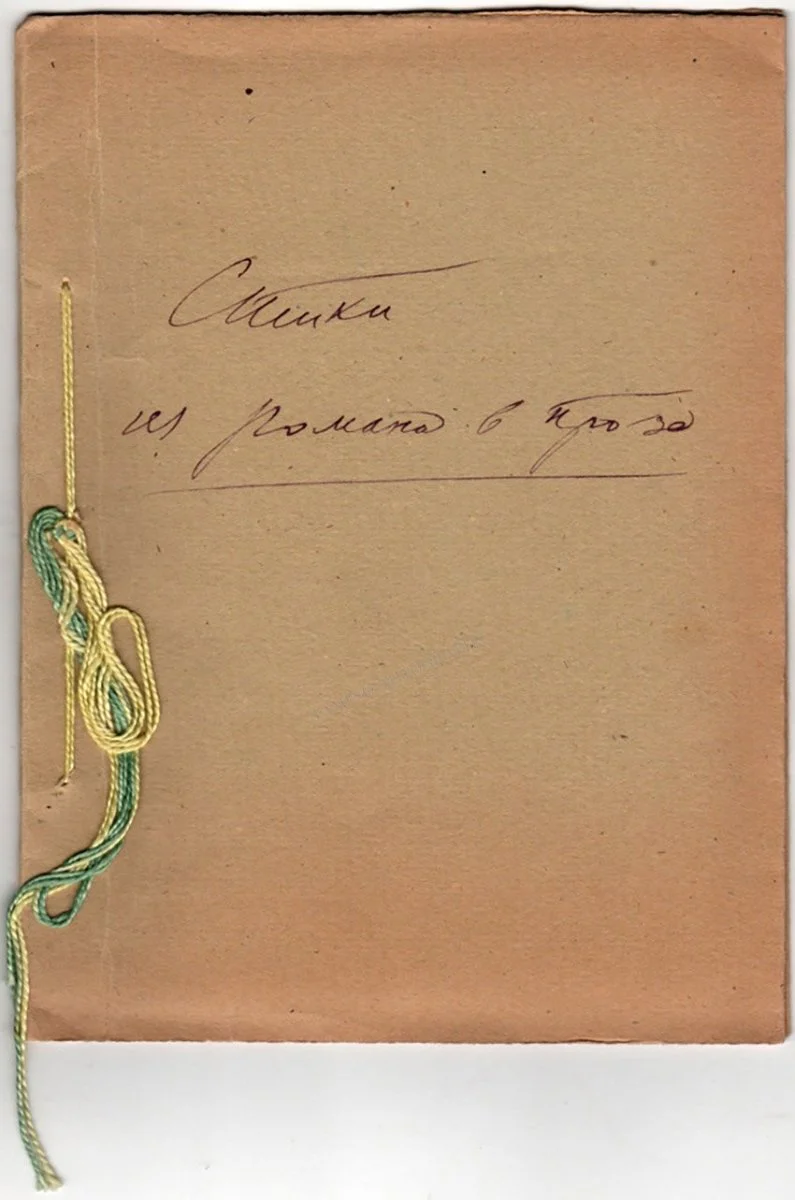
Signed carbon copy of 10 poems, later published in Doctor Zhivago (1957), 20 pages (rectos only), original tan wrappers, size is 6.75 x 9 inches. Inscribed to Iuri Aleksandrovich Afanasiev, a leading reformist intellectual appointed rector of the State History and Archives Institute in 1986. Afanasiev has used his position to shed a more factual light on Stalin´s purges and crimes.
Warmly inscribed on the first blank page: "To dear Iuri Aleksandrovich for good memory in wishing a speedy settling of your home life Pasternak 8 March 1948."
This signed typescript comprises ten of the 25 "Lara" poems in Pasternak's Nobel Prize winning novel Doctor Zhivago (1957). Pasternak was one of Russia's greatest poets when he conceived his epic tale of the Soviet Union. He worked on the novel for many years (the earliest passages date from the 1910s) and composed the poetry at various intervals during its gestation. For example, "Gamlet" [Hamlet] was written in 1946 while Pasternak was working on his celebrated translation of Shakespeare's drama. The date of the composition of "Vesennyaya rasputitsa" [Spring Thaw] has been given as 1953, but the typed copy of the poem included in this 1948 manuscript compilation proves that it was apparently written with the other poems in 1946 and 1947. Pasternak published "Stikhi iz romana v proze 'Doktor Zhivago'" in Znamia (no. 4, 1954, pp 92-95) prior to their appearance in the book. The poems in this carbon vary only slightly in language, capitalization and layout from those in Doctor Zhivago and appear there as numbers 1, 2, 3, 6, 10, 15, 18, 19, 20 and 21.
Pasternak instructed his typist Marina Kazimirovna Baranovich to prepare copies of Stikhi iz romana v proze for distribution among friends. Only four other carbon copies of Stikhi iz romana v proze have been located: one inscribed to Olga Petrovska, Sotheby's, Dec 5, 1991, lot 554; a second inscribed to Pasternak's close friend Mikhail Alexandrovich Zenkevich now in a private collection in Russia; a third inscribed to literary historian M. P. Gromov (Pasternak, Polnoe sobranie sochinenii, 9, pp 515-16); and a fourth inscribed on April 10, 1948 to his translator Cecil Maurice Bowra, Collection of Irwin Holtzman, Hoover Institution Archives.
An extraordinary piece of literary history, Pasternak´s autographs are exceedingly rare, and this is a very rare early manuscript of his most famous work, boldly signed and inscribed by him.
See scan of front cover, first blank page, and one of the pages inside.
Product Information
Product Information
Shipping & Returns
Shipping & Returns
Description
Russian poet, novelist and literary translator (1890-1960), Nobel Prize in Literature in 1958, after his novel Doctor Zhivago was published outside Russia due to a government ban.
Signed carbon copy of 10 poems, later published in Doctor Zhivago (1957), 20 pages (rectos only), original tan wrappers, size is 6.75 x 9 inches. Inscribed to Iuri Aleksandrovich Afanasiev, a leading reformist intellectual appointed rector of the State History and Archives Institute in 1986. Afanasiev has used his position to shed a more factual light on Stalin´s purges and crimes.
Warmly inscribed on the first blank page: "To dear Iuri Aleksandrovich for good memory in wishing a speedy settling of your home life Pasternak 8 March 1948."
This signed typescript comprises ten of the 25 "Lara" poems in Pasternak's Nobel Prize winning novel Doctor Zhivago (1957). Pasternak was one of Russia's greatest poets when he conceived his epic tale of the Soviet Union. He worked on the novel for many years (the earliest passages date from the 1910s) and composed the poetry at various intervals during its gestation. For example, "Gamlet" [Hamlet] was written in 1946 while Pasternak was working on his celebrated translation of Shakespeare's drama. The date of the composition of "Vesennyaya rasputitsa" [Spring Thaw] has been given as 1953, but the typed copy of the poem included in this 1948 manuscript compilation proves that it was apparently written with the other poems in 1946 and 1947. Pasternak published "Stikhi iz romana v proze 'Doktor Zhivago'" in Znamia (no. 4, 1954, pp 92-95) prior to their appearance in the book. The poems in this carbon vary only slightly in language, capitalization and layout from those in Doctor Zhivago and appear there as numbers 1, 2, 3, 6, 10, 15, 18, 19, 20 and 21.
Pasternak instructed his typist Marina Kazimirovna Baranovich to prepare copies of Stikhi iz romana v proze for distribution among friends. Only four other carbon copies of Stikhi iz romana v proze have been located: one inscribed to Olga Petrovska, Sotheby's, Dec 5, 1991, lot 554; a second inscribed to Pasternak's close friend Mikhail Alexandrovich Zenkevich now in a private collection in Russia; a third inscribed to literary historian M. P. Gromov (Pasternak, Polnoe sobranie sochinenii, 9, pp 515-16); and a fourth inscribed on April 10, 1948 to his translator Cecil Maurice Bowra, Collection of Irwin Holtzman, Hoover Institution Archives.
An extraordinary piece of literary history, Pasternak´s autographs are exceedingly rare, and this is a very rare early manuscript of his most famous work, boldly signed and inscribed by him.
See scan of front cover, first blank page, and one of the pages inside.